

The difference between truffles vs mushrooms comes down to which part of the fungus you are looking at. Magic mushrooms are the fruiting bodies that grow above ground. Magic truffles are sclerotia: dense, knobbly masses of mycelium that form underground. Both contain psilocybin and psilocin. In the Netherlands the distinction also has legal weight, because only the mushrooms are banned.
Key takeaways
- Magic truffles are sclerotia, compact underground masses of mycelium; magic mushrooms are the fruiting bodies that grow above ground.
- Both contain psilocybin, which the body converts into psilocin, the compound that acts on the serotonin 5-HT2A receptor.
- Since 1 December 2008 psilocybin mushrooms have been on List II of the Dutch Opium Act, while sclerotia were left outside that measure.
- No controlled study has compared the effects of truffles and mushrooms directly, so claims about different experiences rest on anecdote.
- Outside the Netherlands, psilocybin truffles are illegal in many countries, so readers abroad should check their local law.
In this article
- What is the biological difference between truffles and mushrooms?
- Do truffles and mushrooms contain the same active compounds?
- Are magic truffles weaker than magic mushrooms?
- Why are truffles legal in the Netherlands when mushrooms are not?
- Is the experience of truffles different from mushrooms?
- Are truffles and mushrooms equally safe?
- Which should you choose?
- Frequently asked questions
| Magic truffles | Magic mushrooms | |
|---|---|---|
| Part of the fungus | Sclerotium, a hardened mass of mycelium | Fruiting body (cap and stem) |
| Where it forms | Below the surface of the substrate | Above the surface |
| Look and texture | Firm, irregular lumps, pale brown to golden | Soft, with a cap, gills and stem |
| Active compounds | Psilocybin and psilocin | Psilocybin and psilocin |
| Dutch legal status | Not covered by the 2008 ban; sold in smartshops | On List II of the Opium Act since 1 December 2008 |
What is the biological difference between truffles and mushrooms?
They are two structures of the same organism, built for different jobs. A fungus spends most of its life as mycelium, a network of fine threads running through soil, wood or another substrate. When conditions suit reproduction, some species push up fruiting bodies, the familiar mushrooms, which release spores from their gills.
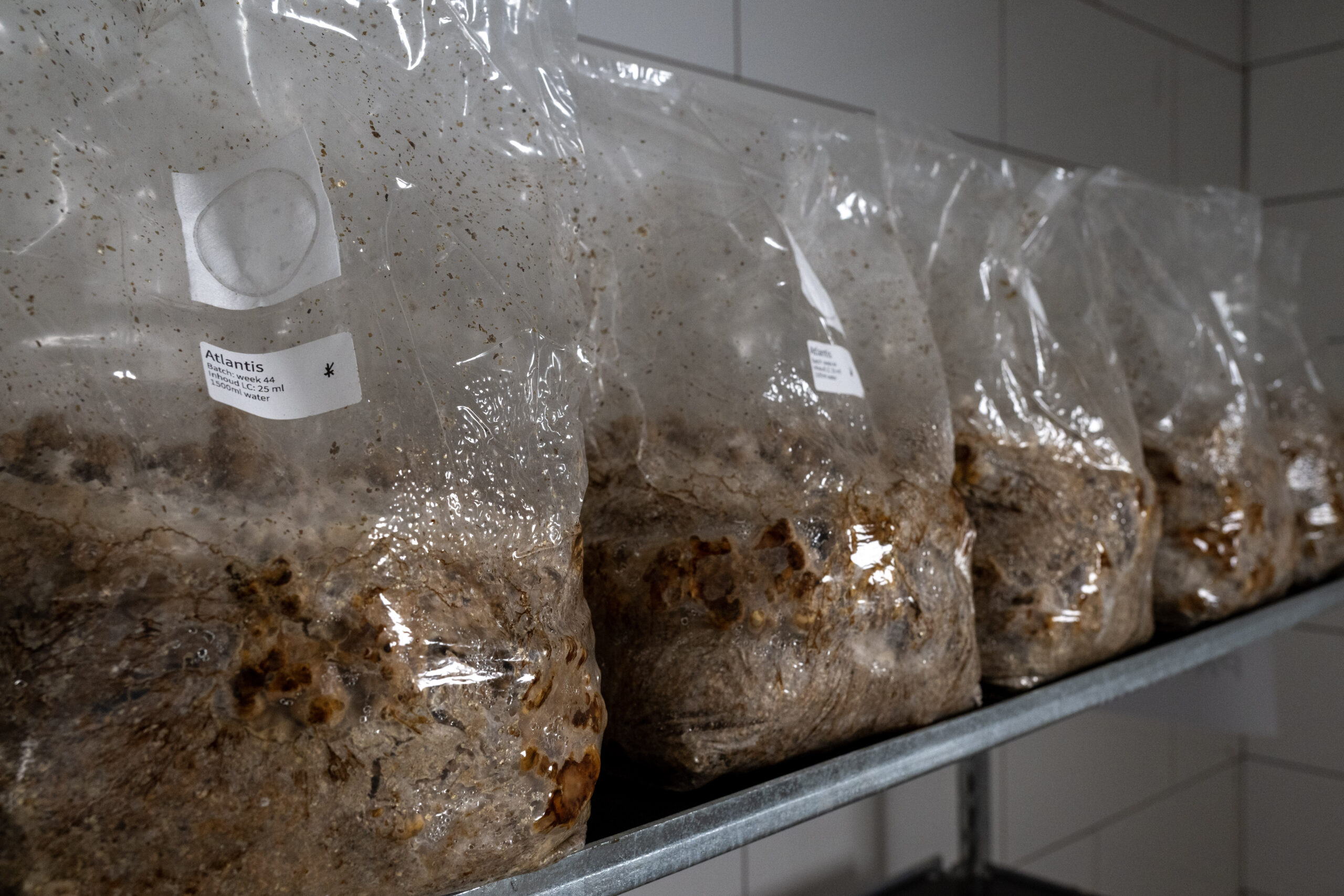
A sclerotium is something else. Some species, under certain conditions, pack their mycelium tightly into a hard, compact lump that works as a reserve. It can sit out dry spells or cold periods and later resume growth. It does not release spores. Not every psilocybin-producing species forms sclerotia. Psilocybe mexicana, the species from which Albert Hofmann first isolated psilocybin in 1958, and Psilocybe tampanensis are two that do.
The word “truffle” is a trade name, borrowed for its resemblance to culinary truffles. Botanically the two have nothing to do with each other. Culinary truffles are the fruiting bodies of entirely different fungi.
Do truffles and mushrooms contain the same active compounds?
Yes. Both contain psilocybin and its active form, psilocin. Psilocybin itself is a prodrug: as Passie et al. described in Addiction Biology in 2002, the body removes a phosphate group to convert it into psilocin. Psilocin is what reaches the brain and acts on serotonin receptors, above all the 5-HT2A receptor that Nichols (2016) identifies as central to the effects of classic psychedelics.
So at the level of chemistry, eating a truffle or a mushroom leads to the same compound acting on the same receptor. A human brain-imaging study by Madsen et al. (2019) found that the intensity of the subjective effects tracked how much psilocin was in the blood and how much of the 5-HT2A receptor was occupied. What the material was called beforehand does not enter into it.
Are magic truffles weaker than magic mushrooms?
You will often read that truffles are milder, and we will not put a figure on it, because the honest answer is that it varies. Psilocybin content depends on species, growing conditions, the age of the material and how it has been stored. The source list we work from contains no study that compares sclerotia and fruiting bodies directly, so any precise comparison you see online is worth treating with suspicion.
Storage alone can make a large difference. Gotvaldová et al. (2021) measured how psilocybin degraded in Psilocybe cubensis under different storage conditions and found that the conditions strongly affected the speed of breakdown. That study used mushroom biomass rather than sclerotia, so it is only indicative for truffles, but it explains why two batches of the same product can differ.
The practical consequence is simple. Do not try to convert an experience with mushrooms into an amount of truffles, or the reverse. Follow the product packaging and product page, and if anything is unclear, ask a doctor or a harm-reduction service such as the Trimbos Institute’s drugsinfo.nl.
Why are truffles legal in the Netherlands when mushrooms are not?
Because the 2008 ban targeted mushrooms specifically and left sclerotia out. Since 1 December 2008 (Staatsblad 2008, 486), psilocybin-containing mushrooms, known in Dutch as paddo’s, have been on List II of the Opium Act. Sclerotia were not included in that measure, so smartshops kept selling magic truffles legally, and still do.
That can look like a contradiction, since psilocybin and psilocin themselves are on List I of the Act, the list commonly referred to as hard drugs. The difference is between a pure substance and a natural product that happens to contain it. You can read the full text of the Opium Act on wetten.overheid.nl.
The Dutch exception does not travel. In many other countries psilocybin truffles are treated the same as mushrooms, which means illegal. If you live outside the Netherlands, check your local law, and do not assume that bringing truffles across a border is allowed. Sales are for adults only.
Is the experience of truffles different from mushrooms?
Users sometimes describe truffles as feeling different, but there is no controlled research that compares the two head to head. Because the active compound is the same, the most plausible explanation for any difference is the amount of psilocin involved, plus expectation and setting.
Expectation is not a small factor in microdosing. In the placebo-controlled self-blinding study by Szigeti et al. (2021), well-being and mood improved in both the microdose and the placebo group, and the differences between them were not significant. Participants who believed they had taken an active dose tended to report effects whether or not they had. If people expect truffles to feel gentler or clearer, that expectation alone may be enough to make them report it.
It is also worth knowing what form the research takes. Cavanna et al. (2022), one of the few double-blind placebo-controlled microdosing studies with psilocybin, used mushrooms, and found no significant effect on cognition, creativity, mood or well-being compared with placebo. For a wider overview of the evidence, see our introduction to what microdosing is.
Are truffles and mushrooms equally safe?
The pharmacological risks are the same, because the compound is the same. Gable (2004) placed psilocybin among the substances with the widest margin between an effective and a lethal dose, and the Dutch review by van Amsterdam et al. (2011) concluded that the harm potential of magic mushrooms is low, with the main risks being behavioural, such as panic, accidents and risky behaviour while intoxicated.
The contraindications do not change with the form either. Lithium combined with a classic psychedelic is linked to seizures (Halman et al., 2024), MAOIs can intensify and prolong effects, and research guidelines exclude people with a personal or family history of psychosis or bipolar I disorder. Our guide to microdosing responsibly sets out the general principles, and the FAQ answers the more practical questions.
One practical difference is freshness. Truffles are often sold fresh, which means they are a perishable product: check the packaging, keep the pouch sealed until you need it, and throw out anything that smells off or shows mould.
Which should you choose?
In the Netherlands the choice is made for you: truffles are the form that can be sold legally. Elsewhere, the question is first a legal one, and you should settle it before anything else.
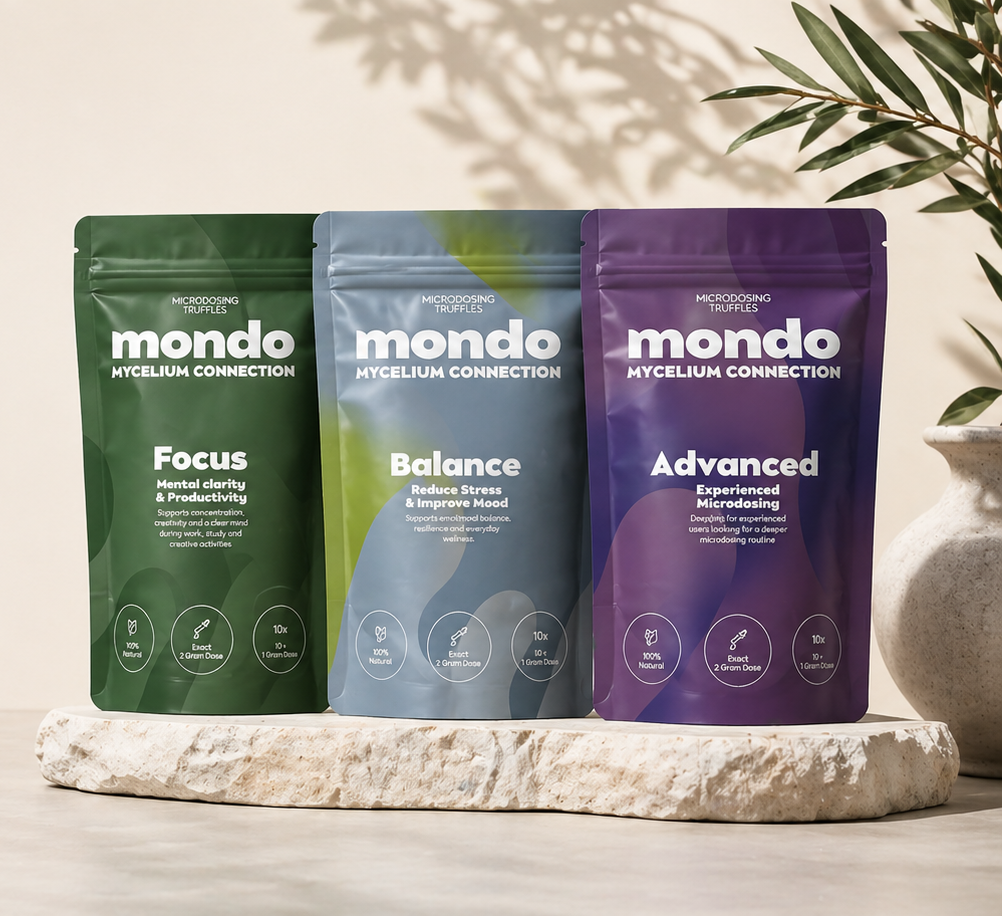
Mondo has grown its own truffles in Purmerend since 2009, which you can read about on the about Mondo page. They are sold fresh, in individually pre-dosed portions in resealable vacuum-sealed pouches, in three blends: Focus, Balance and Advanced, the last for experienced users only. If you are in the Netherlands and want to compare them, the Mondo shop lists all three.
Frequently asked questions
Are magic truffles a kind of mushroom?
They come from the same fungi, but they are not mushrooms in the everyday sense. A mushroom is the fruiting body that grows above ground and releases spores. A magic truffle is a sclerotium, a compact underground mass of mycelium that serves as a reserve. Some psilocybin-producing species, such as Psilocybe mexicana and Psilocybe tampanensis, form these structures.
Do magic truffles contain psilocybin?
Yes. Magic truffles contain psilocybin and psilocin, the same compounds as magic mushrooms. Psilocybin is converted in the body into psilocin, which acts mainly on the serotonin 5-HT2A receptor. The amount present varies with species, growing conditions, age and storage, which is why precise comparisons between truffles and mushrooms are unreliable.
Why can smartshops sell truffles but not mushrooms?
Since 1 December 2008, psilocybin-containing mushrooms have been on List II of the Dutch Opium Act. Sclerotia were not covered by that measure, so they can still be sold legally in Dutch smartshops to adults. This is a Dutch situation only, and in many other countries psilocybin truffles are illegal.
Can I swap mushrooms for truffles one to one?
No, and you should not try to work out a conversion yourself. Psilocybin content varies between species, batches and storage conditions, and there is no reliable research comparing sclerotia with fruiting bodies directly. Follow the product packaging and product page, and ask a doctor or a harm-reduction service such as drugsinfo.nl if you are unsure.
Do culinary truffles have anything to do with magic truffles?
No. The name is borrowed because magic truffles look a little like culinary truffles. Culinary truffles are the underground fruiting bodies of entirely different fungi and contain no psilocybin. Magic truffles are sclerotia of psilocybin-producing species, which is a different structure from a different group of fungi.
Sources
- Dutch Opium Act amendment, Staatsblad 2008, 486 (psilocybin mushrooms added to List II; sclerotia not included). Harm-reduction information: Trimbos Institute, drugsinfo.nl Link
- Passie T, et al. (2002). The pharmacology of psilocybin. Addiction Biology 7(4):357–364
- Gotvaldová K, et al. (2021). Stability of psilocybin and its four analogs in the biomass of the psychotropic mushroom Psilocybe cubensis. Drug Testing and Analysis 13(2):439–446
- Szigeti B, et al. (2021). Self-blinding citizen science to explore psychedelic microdosing. eLife 10:e62878 Link
- Madsen MK, et al. (2019). Psychedelic effects of psilocybin correlate with serotonin 2A receptor occupancy and plasma psilocin levels. Neuropsychopharmacology 44:1328–1334
- Opium Act (Opiumwet), official consolidated text, wetten.overheid.nl
This article is general information, not medical advice. Magic truffles are legal in the Netherlands but prohibited in many other countries, so check your local law. 18+ only. If you use medication or have a medical or mental health condition, consult your doctor first.
Keep reading
What Are Magic Truffles (Sclerotia)? How They Form and Why They Matter
Magic truffles are sclerotia, compact reserves of fungal mycelium. Here is how they form, what they contain and why that form matters to buyers.
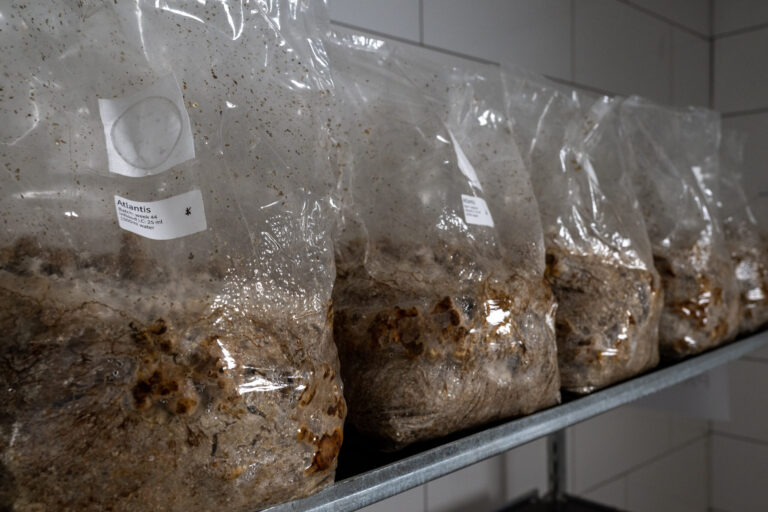
Inside the Production of Premium Microdosing Truffles
Premium microdosing truffles are carefully cultivated and prepared under controlled conditions to ensure consistency, freshness and quality in every dose. From mycelium development and…
What Does the Research Actually Say About Microdosing?
The more rigorous the study, the smaller the effect. A walk through the microdosing research, from surveys to placebo-controlled trials.