

Microdosing is the practice of taking a psychedelic, most often psilocybin from magic truffles or mushrooms, in amounts small enough that the user does not have a trip. People who microdose describe goals such as a steadier mood, clearer focus or easier creative work. Placebo-controlled studies have so far not shown that those effects go beyond what expectation alone produces.
Key takeaways
- Microdosing means taking a psychedelic, usually psilocybin, below the level at which it causes a noticeable trip.
- Observational studies report better mood and well-being among microdosers, but they cannot rule out expectation effects.
- In the placebo-controlled self-blinding study by Szigeti et al. (2021), the microdose and placebo groups improved to a similar degree.
- Psilocybin has low physiological toxicity, but lithium, MAOIs and a history of psychosis or bipolar I disorder are serious red flags.
- Magic truffles are sold legally in the Netherlands; in many other countries psilocybin truffles are illegal.
In this article
How is microdosing defined?
Microdosing means using a psychedelic below the level at which it causes obvious perceptual changes: no visuals, no warped sense of time, nothing that stops you working or holding a conversation. The intention is that you notice little or nothing in the moment.
That is the working definition, and it is looser than it sounds. In their 2019 review in the Journal of Psychopharmacology, Kuypers and colleagues, a team that included Maastricht University researchers, pointed out that studies define microdosing in different ways, which makes their results hard to compare. One study’s “microdose” is not necessarily another’s. The substances differ as well. Psilocybin and LSD are the two most common, and a good share of the controlled laboratory research has used LSD, not psilocybin.
It also helps to separate microdosing from the full-dose psilocybin used in clinical trials for depression, such as Carhart-Harris et al. (2021) and Goodwin et al. (2022), both in the New England Journal of Medicine. Those trials gave high doses in a therapy setting with psychological support. Their results say nothing direct about microdosing, although headlines regularly blur the two.
Where does the idea of microdosing come from?
Psilocybin entered Western science in the late 1950s, and microdosing as a named practice took off after 2011. In 1957 R. Gordon Wasson described a Mazatec mushroom ceremony led by the curandera María Sabina in Oaxaca, Mexico, in an article for Life magazine. The following year Albert Hofmann at Sandoz isolated psilocybin and psilocin from Psilocybe mexicana, and he later synthesised psilocybin.
The modern practice owes most to the American psychologist James Fadiman. His 2011 book The Psychedelic Explorer’s Guide popularised the idea of taking very small amounts as part of ordinary life. He later published a collection of self-reports from microdosers (Fadiman and Korb, 2019). Most were positive, but the authors presented the work as exploratory. There was no control group, and people who choose to send in reports are rarely a representative sample.
Why do people microdose?
Surveys keep finding the same two motives: performing better and feeling better. Hutten et al. (2019), writing in the International Journal of Neuropsychopharmacology, found performance enhancement and mood to be the leading reasons among users. Lea et al. (2020), in the International Journal of Drug Policy, recorded mental health, performance and plain curiosity.
In Rootman et al. (2021), a Scientific Reports survey of more than 8,000 people, roughly 4,000 of whom microdosed, health-related motives were common. Interview research adds texture. Johnstad (2018) spoke at length with 21 microdosers. Most described better mood, more energy and sharper focus, while some described unwanted stimulation or anxiety. Those accounts are useful for understanding what people are looking for. They are not evidence that the substance delivers it.
What does the research on microdosing show?
Open-label and observational studies tend to find improvements, while placebo-controlled studies mostly do not find them beyond placebo. The table sets out the main designs and what each found.
| Study | Design | Main finding |
|---|---|---|
| Polito & Stevenson (2019), PLoS ONE | 98 people tracked for 6 weeks, no placebo | Reported less depression and stress, more absorption, and unexpectedly more neuroticism |
| Rootman et al. (2021), Scientific Reports | Cross-sectional online survey, 8,000+ people | Microdosers reported lower anxiety, depression and stress than non-microdosers; cause cannot be established |
| Rootman et al. (2022), Scientific Reports | Observational, about 30 days | Small-to-moderate mood improvements versus controls; neither randomised nor blinded |
| Szigeti et al. (2021), eLife | Self-blinding, placebo-controlled, about 190 completers | Both groups improved; the differences were not significant |
| Cavanna et al. (2022), Translational Psychiatry | Double-blind, placebo-controlled, 34 people | No significant effect on cognition, creativity, mood or well-being |
| Marschall et al. (2022), Journal of Psychopharmacology | Preregistered, placebo-controlled | No effect on emotion-related symptoms or processing beyond placebo |
The pattern is fairly consistent. When participants know they are microdosing, they tend to report benefits. When they don’t know, the placebo group reports them too. In the self-blinding study by Szigeti and colleagues, many participants guessed correctly whether they had taken an active dose, and their guesses tracked the effects they described. Kaertner et al. (2021) found that positive expectations beforehand predicted the improvements people reported later.
None of this proves microdosing does nothing. Ona and Bouso (2020) describe the overall results as mixed, with a substantial placebo influence. One home-based trial of microdosed LSD in healthy men (Murphy et al., 2023) did find mood elevation on dosing days compared with placebo, though no benefit on cognition or creativity, and it used LSD rather than psilocybin. What the research does show is that popular claims run well ahead of the evidence.
Is microdosing safe?
Psilocybin has low physiological toxicity, but low risk is not zero risk, and some people should not use it at all. In a 2004 comparison in Addiction, Gable placed psilocybin among the substances with the widest margin between an effective and a lethal dose. A Dutch review by van Amsterdam, Opperhuizen and van den Brink (2011) concluded that magic mushrooms have low harm potential and are not addictive, and that the main risks are behavioural: panic, accidents and risky behaviour while intoxicated.
Microdosing raises its own open questions:
- Side effects. Users surveyed by Hutten et al. (2019) reported nausea and other physical discomfort, more anxiety, and in some cases trouble with sleep or concentration.
- Medication interactions. A 2024 systematic review by Halman et al. links lithium plus classic psychedelics to seizures, notes that MAOIs can intensify and prolong effects, and that SSRIs may blunt them. Nayak et al. (2021) found seizures mentioned in about 47% of online reports involving lithium.
- Repeated use. Psilocin has affinity for the 5-HT2B receptor, and long-term activation of that receptor is linked to heart valve disease. Rouaud, Calder and Hasler (2024) call the risk from repeated microdosing theoretical but unstudied.
- Mental-health history. Research safety guidelines (Johnson, Richards and Griffiths, 2008) exclude people with a personal or family history of psychotic disorders or bipolar I disorder.
Ona and Bouso also note that long-term safety data on microdosing is lacking. If you take prescription medication, talk to your doctor first, and never stop or change medication on your own.
Is microdosing legal?
That depends on where you are. In the Netherlands, psilocybin-containing mushrooms were added to List II of the Opium Act on 1 December 2008. Sclerotia, sold as magic truffles, are not covered by that measure and are sold legally in Dutch smartshops to adults. Psilocybin and psilocin as substances remain on List I.
In many countries psilocybin truffles are illegal. Czechia is a narrow exception: from 1 January 2026 psilocybin can be prescribed for medical use under strict conditions in therapy settings, which is not the same as legal personal use. If you live outside the Netherlands, check your local law first, and don’t assume that taking truffles across a border is legal.
How do you start microdosing responsibly?
We don’t publish amounts, schedules or preparation methods, and you should be wary of anyone online who gives them with great confidence. For questions about how much or how often, the reliable places are the product packaging and product page, your doctor, and harm-reduction services such as the Trimbos Institute’s drugsinfo.nl. Our microdosing guide sets out the general principles, and the frequently asked questions cover the practical side.
A few harm-reduction principles hold regardless of product:
- Be 18 or older, and check the law where you live.
- Rule out contraindications first, especially medication and mental-health history.
- Start low and pay attention to how you respond.
- Don’t combine with alcohol or other substances.
- Don’t drive or operate machinery.
- If you are unsure how you will react, have a sober friend available.
- Keep notes, and be honest about whether anything is actually changing, given how large a role expectation plays.
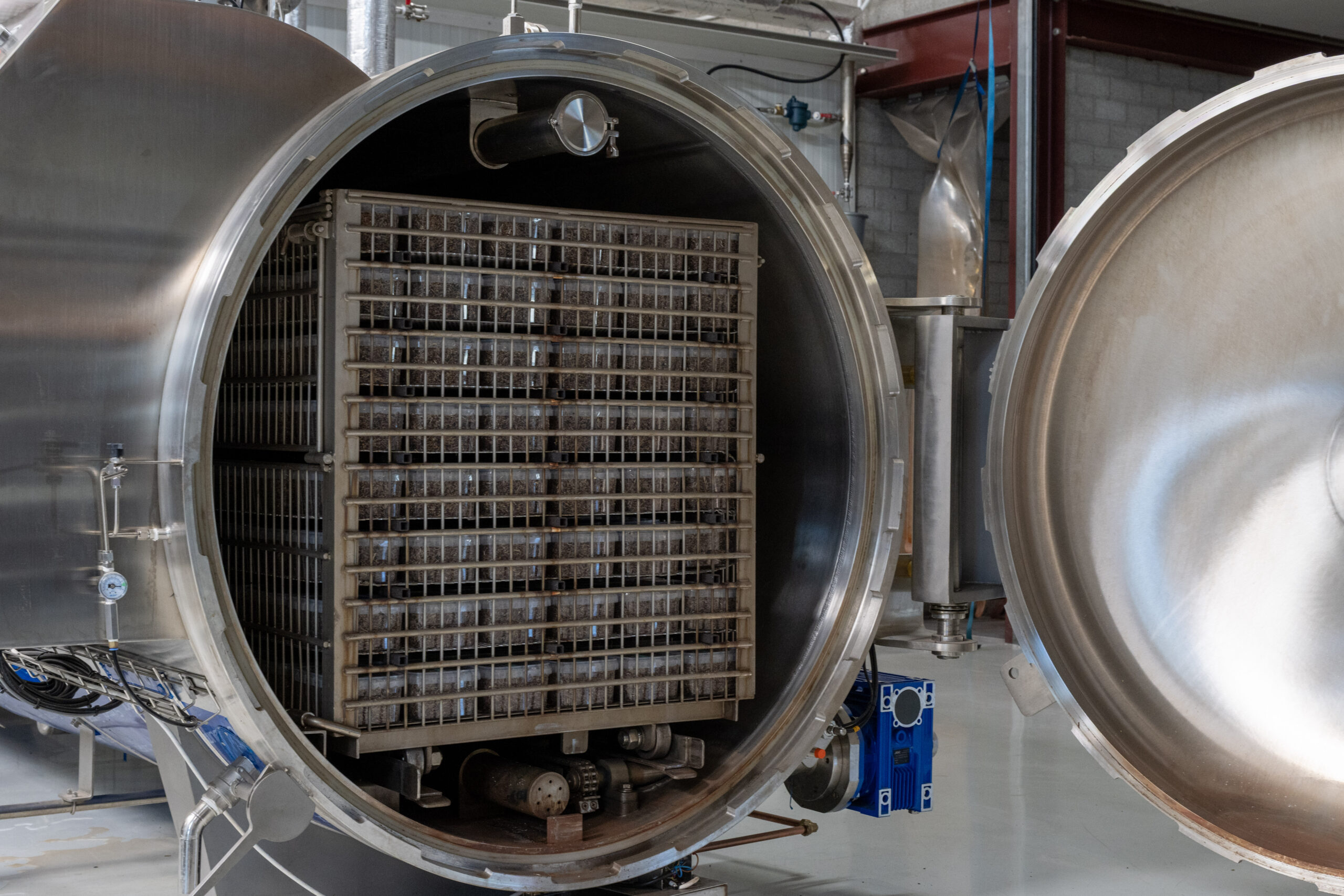
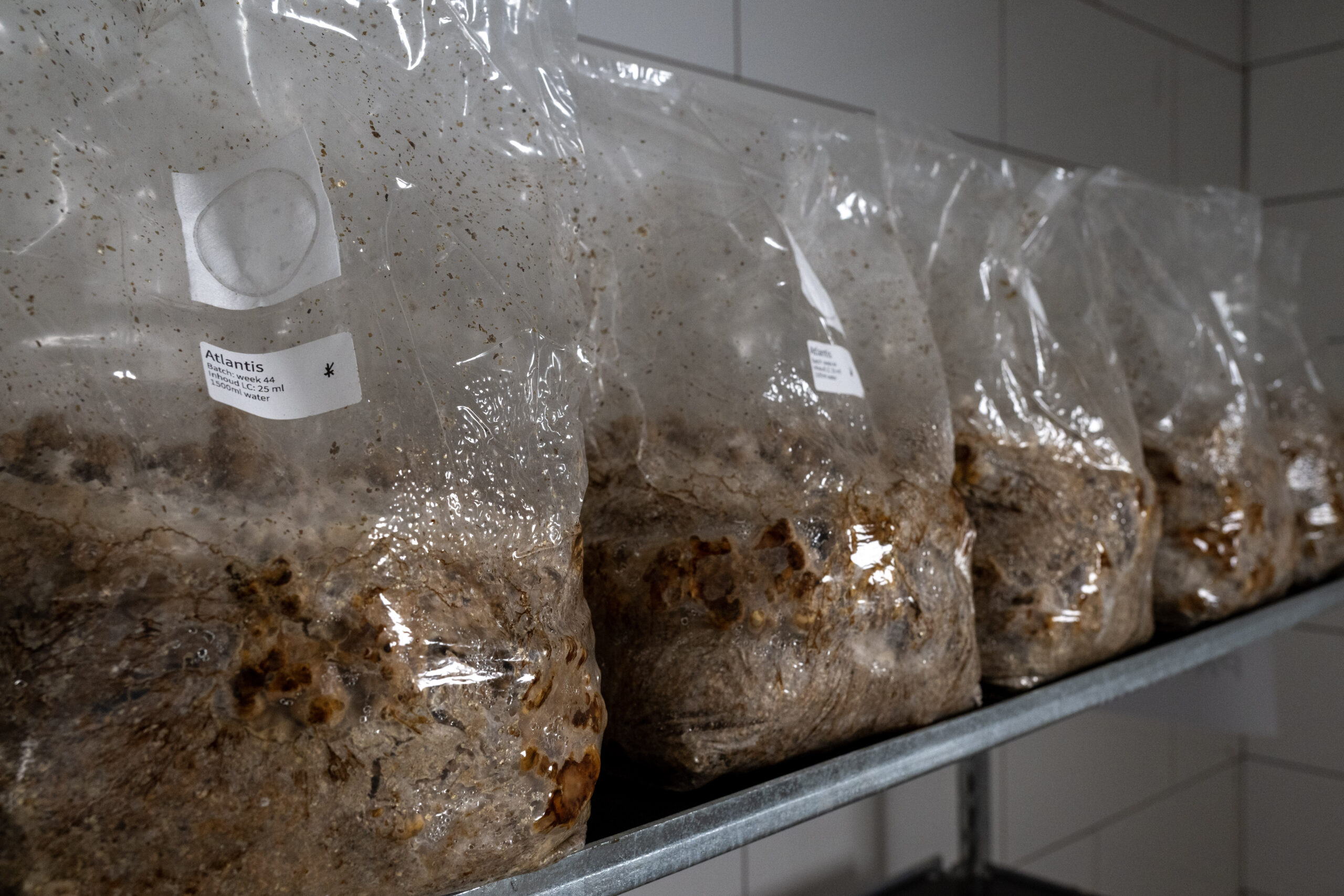
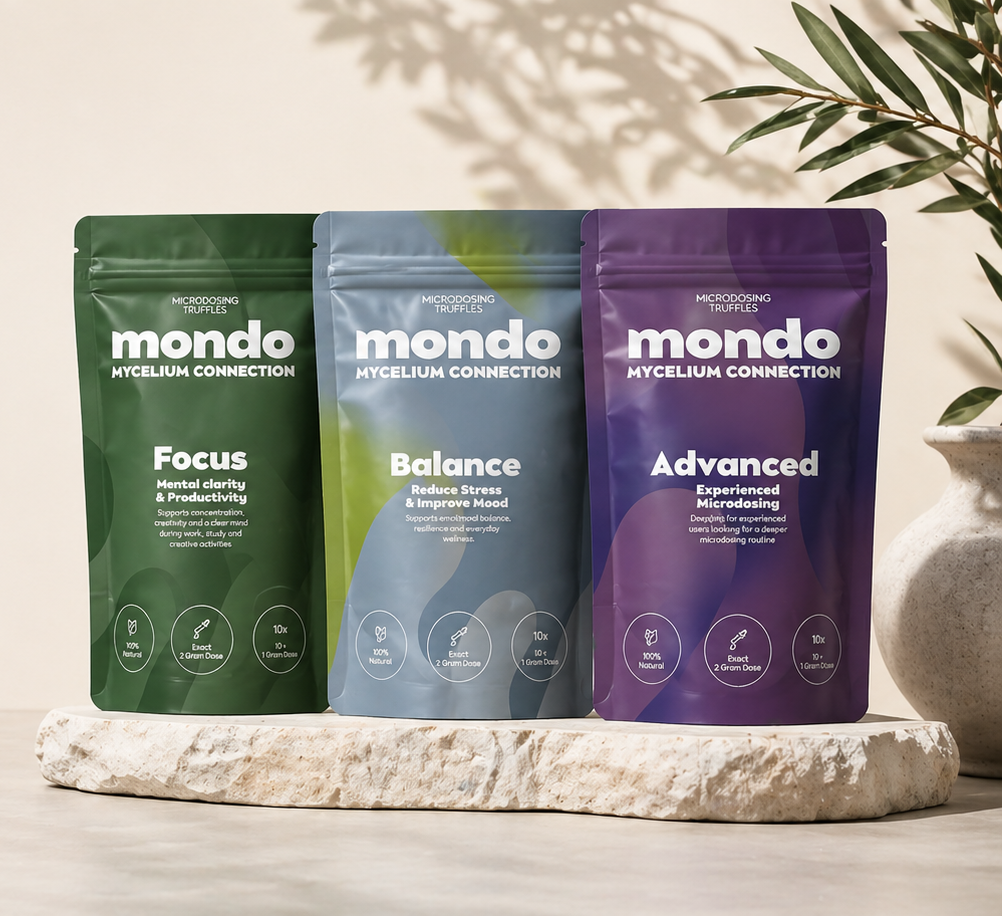
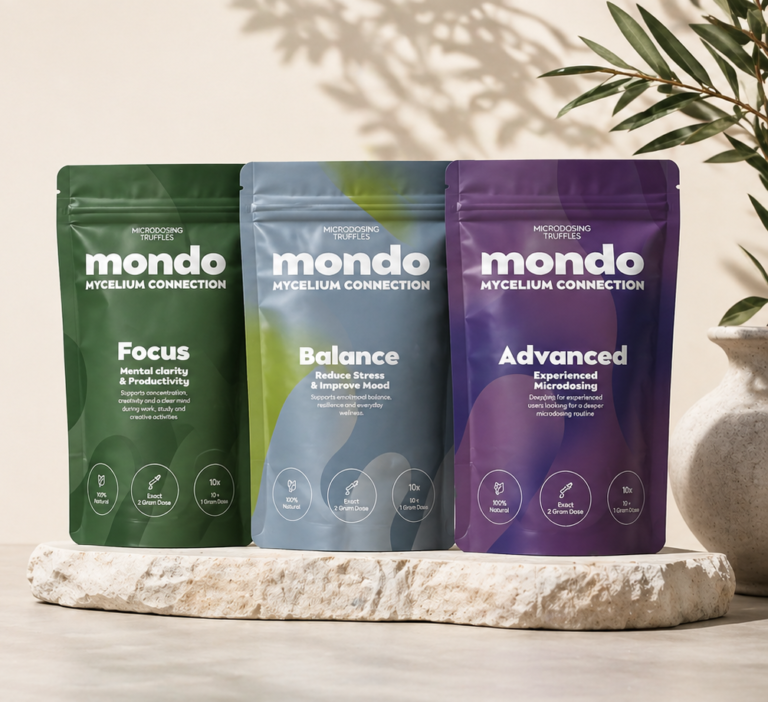
Mondo has grown its truffles in-house in Purmerend since 2009, and the story behind the company explains how that started. They are sold fresh, in individually pre-dosed portions in resealable vacuum-sealed pouches, in three blends: Focus, Balance and Advanced, the last intended for experienced users. You can compare them in the truffle shop, and read how ordering works before you do.
Frequently asked questions
Do you feel anything when you microdose?
The intention is that you feel little or nothing obvious. Some users report subtle changes in mood or energy, and some report side effects such as nausea, anxiety or poorer sleep. In placebo-controlled studies many participants could guess whether they had taken an active dose, and those guesses tracked what they reported, which suggests expectation shapes much of the experience.
Is microdosing the same as psilocybin therapy?
No. The psilocybin therapy trials published in the New England Journal of Medicine used full doses, given in a clinical setting with psychological support. Microdosing uses amounts below the level of a noticeable trip, usually without any therapeutic setting. Results from full-dose trials cannot be transferred to microdosing, and the two are often confused in media coverage.
Is microdosing addictive?
A Dutch review by van Amsterdam and colleagues (2011) concluded that magic mushrooms are not addictive and have low harm potential, with the main risks being behavioural, such as panic or accidents. That review covered psilocybin mushroom use in general. Long-term safety data specific to repeated microdosing is still lacking, so caution remains sensible.
Can I microdose if I take antidepressants or other medication?
Speak to your doctor before considering it, and do not stop or change medication on your own. A 2024 systematic review found that SSRIs may blunt psychedelic effects, MAOIs can intensify and prolong them, and lithium combined with classic psychedelics is linked to seizures. The evidence base is limited and mostly made up of case reports and surveys.
Where are magic truffles legal?
Magic truffles (sclerotia) are sold legally to adults in the Netherlands, because the 2008 ban on psilocybin mushrooms did not cover them. In many other countries psilocybin truffles are illegal, and taking them across borders is not something to assume is allowed. Always check the law in your own country before buying.
Sources
- Szigeti B, et al. (2021). Self-blinding citizen science to explore psychedelic microdosing. eLife 10:e62878 Link
- Rootman JM, et al. (2021). Adults who microdose psychedelics report health related motivations and lower levels of anxiety and depression compared to non-microdosers. Scientific Reports 11:22479
- Kuypers KPC, et al. (2019). Microdosing psychedelics: More questions than answers? An overview and suggestions for future research. Journal of Psychopharmacology 33(9):1039–1057
- Hutten NRPW, et al. (2019). Motives and side-effects of microdosing with psychedelics among users. International Journal of Neuropsychopharmacology 22(7):426–434
- van Amsterdam J, Opperhuizen A, van den Brink W (2011). Harm potential of magic mushroom use: a review. Regulatory Toxicology and Pharmacology 59(3):423–429
- Dutch Opium Act amendment, Staatsblad 2008, 486 (psilocybin mushrooms added to List II; sclerotia not included). Harm-reduction information: Trimbos Institute, drugsinfo.nl Link
This article is general information, not medical advice. Magic truffles are legal in the Netherlands but prohibited in many other countries, so check your local law. 18+ only. If you use medication or have a medical or mental health condition, consult your doctor first.
Keep reading
The Modern Guide to Premium Microdosing Truffles
Microdosing truffles has evolved into a modern wellness practice embraced by professionals, entrepreneurs, creatives and mindful individuals seeking greater clarity, emotional balance and intentional…
What Does the Research Actually Say About Microdosing?
The more rigorous the study, the smaller the effect. A walk through the microdosing research, from surveys to placebo-controlled trials.
Who Should Not Microdose? Contraindications Explained
Some people should not microdose at all. The main contraindications, from psychosis history to lithium and MAOIs, and what the evidence behind each says.